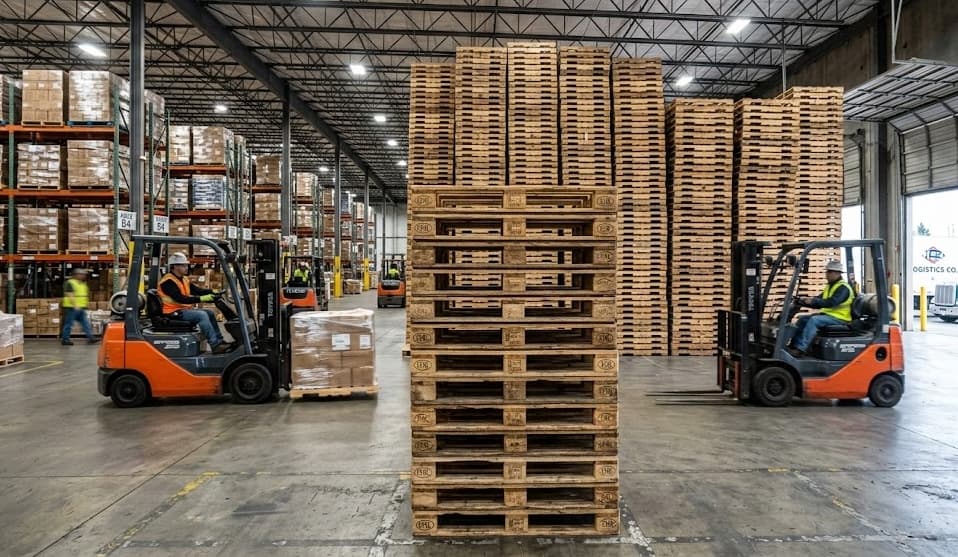
Pallet damage costs businesses billions of dollars annually in replacements, product damage, and workplace injuries. Most damage is preventable with proper handling practices and awareness. Here's what to watch for and how to prevent it.
Forklift Damage
By far the most common cause of pallet damage. Forklift tines puncture deck boards, crack stringers, and shatter blocks when operators are rushed, inattentive, or working with poor visibility. Fork damage accounts for an estimated 30% of all pallet failures.
Prevention: train forklift operators to approach pallets squarely, not at an angle. Ensure forks are properly spaced for the pallet width. Use approach lines painted on warehouse floors. And never — ever — use forklift tines to push pallets sideways.
Overloading
Loading a pallet beyond its rated capacity causes boards to crack, stringers to bow, and in severe cases, complete structural failure. This is especially dangerous when overloaded pallets are stacked in racking systems.
Prevention: know the load rating of your pallets and train staff to check weights before loading. Use higher-rated pallets for heavy products rather than overloading standard ones.
Moisture Damage
Wood absorbs moisture from rain, snow, humidity, and wet floors. Prolonged exposure causes warping, swelling, rot, and mold growth — all of which compromise structural integrity and create sanitation issues.
Prevention: store pallets indoors or under cover whenever possible. If outdoor storage is necessary, elevate pallets off the ground and cover the tops of stacks. Rotate stock to prevent any pallets from sitting in damp conditions for extended periods.
Nail Problems
Protruding nails are both a safety hazard (lacerations, punctured products) and a structural issue (loose nails reduce joint strength). Nails can work loose due to vibration during shipping, impacts, or repeated loading and unloading cycles.
Prevention: inspect pallets before use and reject any with protruding nails. During repair, use ring-shank or helical nails that resist withdrawal better than smooth nails.
Dragging and Dropping
Dragging pallets across rough surfaces destroys bottom deck boards. Dropping loaded pallets — even from a few inches — can crack boards and split stringers from the sudden impact.
Prevention: always use proper lifting equipment. Never drag a loaded pallet. When stacking, lower pallets gently rather than dropping them.