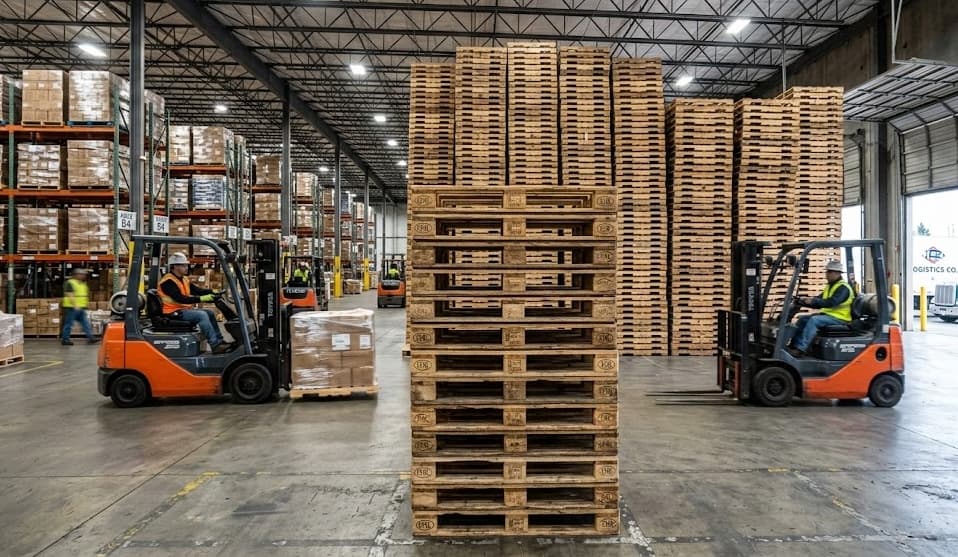
Export Compliance
Heat Treatment (ISPM 15)
Certified heat treatment for international shipping compliance. Quick turnaround with full documentation.
What is ISPM 15?
ISPM 15 (International Standards for Phytosanitary Measures No. 15) is a set of guidelines developed by the International Plant Protection Convention (IPPC) that require all wood packaging materials used in international trade to be treated to kill pests and diseases.
The standard was created to prevent the spread of invasive species — like the Asian longhorned beetle and pine wood nematode — that can devastate forests and ecosystems when transported in untreated wood packaging across borders.
The most common treatment method is heat treatment (HT), where wood is heated to a core temperature of 56°C (132.8°F) for a minimum of 30 minutes. This effectively eliminates pests, fungi, and pathogens without chemicals.
All ISPM 15 compliant pallets receive an official stamp indicating the treatment method, the country of origin, and our unique producer code. This stamp is recognized by customs authorities worldwide and serves as proof of compliance.
As a certified heat treatment provider, Sacramento Pallet Co. operates our own treatment kilns capable of processing large volumes with consistent quality. We serve exporters, freight forwarders, logistics companies, and manufacturers throughout the Sacramento region.
Treatment Specifications
Chemical-Free Process
Unlike methyl bromide fumigation, our heat treatment process uses no chemicals whatsoever. It's the most environmentally friendly way to meet international shipping regulations — consistent with our commitment to sustainability. Methyl bromide is an ozone-depleting substance and is being phased out globally under the Montreal Protocol.
How Our Heat Treatment Works
A controlled, documented process from intake to certification.
Intake & Inspection
Pallets are received, inspected, and sorted by size and type. Damaged pallets are flagged for repair before treatment. Moisture content is measured.
Kiln Loading
Pallets are loaded into our industrial treatment kilns with proper spacing to ensure uniform heat distribution. Temperature probes are placed at multiple points including wood cores.
Heat Treatment
The kiln is heated until all core temperature probes read 56°C minimum. This temperature is maintained for a minimum of 30 minutes. The entire cycle is digitally recorded.
Stamping & Delivery
After cooling, each pallet receives the official IPPC/ISPM 15 stamp. A Certificate of Treatment is generated. Pallets are delivered or held for pickup.
When Do You Need Heat Treatment?
International Shipping
Any wood packaging (pallets, crates, dunnage) crossing international borders must be ISPM 15 compliant. Most countries enforce this requirement strictly with inspections at port of entry.
Export Compliance
Customs authorities can reject or quarantine shipments on non-compliant pallets. Avoid costly delays, storage fees, re-treatment costs, and potential fines by ensuring compliance before shipping.
Food & Pharmaceutical
While not always legally required for domestic shipments, heat treatment is often requested by food and pharmaceutical companies as an additional safety measure to ensure pest-free wood packaging.
Countries That Enforce ISPM 15
Over 180 countries have adopted ISPM 15 as part of their phytosanitary regulations. Enforcement levels vary — some countries inspect every shipment, while others use risk-based random sampling.
The following major trading nations are known for strict enforcement. If you're shipping to any of these destinations, ISPM 15 compliance is essential to avoid delays and penalties.
Non-Compliance Consequences
Shipping on non-compliant wood packaging can result in serious consequences at the destination country:
Shipment Rejection
Your entire shipment can be refused entry and returned to origin at your expense.
Quarantine & Fumigation
Goods may be held in quarantine and fumigated at the destination — at the shipper's expense. This can cost thousands of dollars.
Fines & Penalties
Customs authorities may impose fines for non-compliance. Repeat violations can result in increased scrutiny on future shipments.
Relationship Damage
Delays and complications from non-compliance can damage relationships with customers, freight forwarders, and customs brokers.
Shipment Destruction
In extreme cases (especially for agricultural products), the entire shipment may be destroyed to prevent pest introduction.
What We Can Heat Treat
Our treatment kilns accommodate all types of wood packaging materials — not just pallets.
Standard Pallets
All sizes from 36x36" to 48x48" and beyond. Stringer and block construction. New and used pallets.
Custom & Oversized Pallets
Non-standard sizes, heavy-duty platforms, and specialty pallets up to 120" in any dimension.
Wood Crates & Boxes
Shipping crates, plywood boxes, and custom wood containers of all sizes and configurations.
Dunnage & Blocking
Loose lumber, blocking, bracing, and dunnage materials used to secure cargo in shipping containers.
Skids & Runners
Heavy-duty skids, runners, and platform bases for industrial equipment and machinery.
Pallet Collars & Frames
Hinged wooden collar frames used for creating stackable bins on standard pallets.
Understanding the IPPC Stamp
Every treated pallet receives an official IPPC mark. Here's what each element means.
IPPC Logo
The official International Plant Protection Convention symbol, indicating the pallet complies with international phytosanitary standards.
Country Code (US)
Two-letter ISO country code identifying where the treatment was performed. "US" for United States.
Producer Code
A unique number assigned to the treatment provider (Sacramento Pallet Co.). This allows traceability back to our facility.
Treatment Code (HT)
"HT" indicates heat treatment was used. "MB" would indicate methyl bromide fumigation (we do not use this method).
DB (Debarked)
Indicates the wood has been debarked as required by ISPM 15. All bark must be removed before treatment.
Stamp Placement
The mark must be visible on at least two opposite sides of the pallet. It must be permanent, legible, and not hand-drawn.
Separating Fact from Fiction
5 Common Heat Treatment Myths Debunked
There's a lot of misinformation about heat treatment for pallets. Here are the five myths we hear most often — and the truth behind each one.
“Heat treatment weakens the wood”
MYTHFalse. The ISPM 15 heat treatment process heats wood to just 56°C (132.8°F) — well below the temperature threshold where wood fibers begin to degrade (which is above 200°C). At these low temperatures, the treatment kills pests and pathogens without affecting the structural integrity, strength, or load-bearing capacity of the wood. In fact, the gentle drying that occurs during heat treatment can slightly improve dimensional stability by reducing moisture content.
“Chemical treatment is the same as heat treatment”
MYTHFalse. Chemical treatment (methyl bromide fumigation) and heat treatment are fundamentally different processes. Methyl bromide is a toxic, ozone-depleting gas that leaves chemical residues in the wood. Heat treatment uses only thermal energy — no chemicals whatsoever. Many countries are phasing out methyl bromide under the Montreal Protocol, and several major importers (including the EU) already prohibit it entirely. Heat treatment is the safer, cleaner, and more widely accepted method.
“Only pallets used for exports need heat treatment”
MYTHFalse. While ISPM 15 compliance is legally required for international shipping, many domestic industries voluntarily require heat-treated pallets for additional safety. Food and beverage companies often specify heat treatment to ensure pest-free packaging. Pharmaceutical manufacturers require it as part of Good Manufacturing Practice (GMP) compliance. Some domestic retailers and distributors also require it as part of their supply chain quality standards.
“The heat treatment wears off over time”
MYTHFalse. Once wood has been heat treated to ISPM 15 specifications (56°C core temperature for 30 minutes), the treatment is permanent. There is no expiration date on a properly treated pallet. The IPPC stamp remains valid indefinitely. The only situation requiring re-treatment is when significant wood components are replaced during repair — in that case, the new wood needs to be treated to maintain compliance.
“All wood pallets need heat treatment”
MYTHFalse. Heat treatment is only required for wood pallets crossing international borders under ISPM 15 regulations. Pallets used exclusively for domestic shipping within the United States do not require heat treatment by law. However, as noted above, certain industries and companies may require it voluntarily for quality and safety reasons. Plastic pallets, metal pallets, and pallets made from processed wood materials (like plywood or OSB) are exempt from ISPM 15 requirements entirely.
Your Compliance Paperwork
Treatment Documentation Explained
When we heat treat your pallets, you receive two forms of documentation: the physical IPPC stamp on each pallet, and a Certificate of Treatment for your shipping records. Together, these provide complete proof of compliance for customs authorities worldwide.
The IPPC stamp is the internationally recognized mark that customs inspectors look for at ports of entry. It's applied directly to the pallet using a permanent branding iron and must appear on at least two opposite sides of the pallet. The stamp contains specific codes that identify the treatment provider, country of treatment, and method used.
The Certificate of Treatment is a detailed paper document that accompanies your shipment. It records the treatment date, batch number, temperature data, treatment duration, and our facility information. Freight forwarders and customs brokers use this certificate to prepare shipping documentation and respond to customs inquiries.
How to Read the ISPM 15 Stamp
IPPC Symbol (Wheat Ears)
Indicates compliance with International Plant Protection Convention standards. This is the universal identifier recognized by customs authorities in over 180 countries.
XX-000 (Country & Producer Code)
The first two letters are the ISO country code (US = United States). The numbers are the unique producer code assigned to our facility by APHIS (Animal and Plant Health Inspection Service).
HT (Treatment Method)
Stands for "Heat Treatment." This confirms the pallet was heated to 56°C core temperature for a minimum of 30 minutes. If you see "MB," that indicates methyl bromide fumigation (not used by our facility).
DB (Debarked)
Confirms that all bark has been removed from the wood as required by ISPM 15. Bark can harbor pests even after heat treatment, so debarking is a mandatory step.
Certificate of Treatment Includes
Compliance by Industry
Industry-Specific Requirements
Different industries have different standards when it comes to wood packaging. Here's how heat treatment fits into the compliance requirements for key sectors.
Food & Beverage
FDA / FSMA Compliance
The food industry has some of the strictest requirements for pallet hygiene. The FDA's Food Safety Modernization Act (FSMA) requires that food packaging materials — including pallets — be free from contamination that could adulterate food products.
Key Requirements
Industry Note
Major grocery retailers and food distributors are increasingly requiring heat-treated pallets even for domestic shipments. Having ISPM 15 compliance positions your products to meet the most demanding supply chain standards.
Pharmaceuticals
GMP / GDP Requirements
Good Manufacturing Practice (GMP) and Good Distribution Practice (GDP) standards in the pharmaceutical industry require that packaging materials not introduce contamination risks to drug products. Wood pallets are a known vector for biological contaminants.
Key Requirements
Industry Note
Pharmaceutical companies typically maintain strict vendor qualification processes for pallet suppliers. Our heat treatment certification, documentation practices, and quality management systems are designed to meet these rigorous standards.
Agriculture
USDA / APHIS Requirements
The USDA's Animal and Plant Health Inspection Service (APHIS) enforces ISPM 15 for all wood packaging entering or leaving the United States. For agricultural products, compliance is particularly critical because pest introduction can devastate crops and ecosystems.
Key Requirements
Industry Note
Sacramento's role as a major agricultural hub means many local growers, packers, and processors need reliable heat treatment for export. Our location and capacity make us the convenient choice for Central Valley and Northern California agricultural businesses.
Heat Treatment FAQ
How long does heat treatment take?
The actual treatment cycle takes 6-12 hours depending on the volume and density of the wood. Including intake, loading, treatment, cooling, stamping, and preparation for delivery, typical turnaround is 24-48 hours.
Does heat treatment damage the pallets?
No. Heat treatment at 56°C is well below the point where wood structure is affected. Pallets retain their full structural integrity after treatment. In fact, the drying effect can slightly improve wood stability.
Is the treatment permanent?
Yes. Once wood has been heat treated to ISPM 15 specifications, it remains compliant indefinitely — there's no re-treatment requirement. However, if significant wood components are replaced (e.g., during repair), the pallet must be re-treated.
Can you treat pallets we didn't buy from you?
Absolutely. We treat pallets from any source — your own stock, pallets from other suppliers, or new pallets you've manufactured. We also treat crates, dunnage, and other wood packaging.
Do you provide documentation for customs?
Yes. Every treatment batch receives a Certificate of Treatment documenting the treatment date, method, temperatures achieved, and duration. This certificate can be presented to customs authorities or freight forwarders as proof of compliance.
What's the difference between heat treatment and kiln drying?
Heat treatment (HT) to ISPM 15 requires the wood core to reach 56°C for 30 minutes — this kills pests. Kiln drying (KD) is focused on reducing moisture content and may or may not reach pest-kill temperatures. All our heat treatment also includes debarking (DB) as required by the standard.
Can already-used pallets be heat treated?
Yes. Both new and used pallets can be heat treated. We recommend inspecting and repairing used pallets before treatment to ensure they're structurally sound. We can handle repair and treatment as a combined service.
Common Questions
Frequently Asked Questions
What is ISPM 15 heat treatment?
ISPM 15 is an international standard requiring wood packaging materials to be heat treated to a core temperature of 56°C for 30 minutes. This eliminates pests and pathogens without using chemicals.
Do I need heat-treated pallets for international shipping?
Yes, most countries require ISPM 15 certified pallets for wood packaging in international trade. Heat treatment is mandatory for exports to the EU, China, Australia, and over 180 other countries.
How long does the heat treatment process take?
Our in-house kilns complete heat treatment within 24-48 hours from receipt. This is significantly faster than outsourcing to third-party treatment facilities.
How can I identify a heat-treated pallet?
Heat-treated pallets carry the official IPPC stamp showing the country code, treatment facility number, and HT designation. We stamp every treated pallet with full compliance markings.
Can you heat treat pallets I already own?
Yes, we offer standalone heat treatment service for customer-owned pallets. Bring your pallets to our facility or arrange pickup, and we will treat, stamp, and return them within 24-48 hours.
Export Readiness
Complete Export Compliance Checklist
Heat treatment is one piece of the export compliance puzzle. Use this checklist to ensure your wood packaging is fully ready for international shipment.
Verify ISPM 15 Treatment
Confirm all wood packaging materials (pallets, crates, dunnage, blocking, bracing) have been heat treated and carry a legible IPPC/HT stamp. Treatment must bring the wood core to 56°C for 30 minutes minimum.
Check IPPC Mark Placement
The IPPC mark must be on at least two opposite sides of the wood packaging. It must be legible, permanent (burned or ink-stamped), and include the country code, producer number, and treatment method (HT).
Confirm Debarking
ISPM 15 requires that all wood packaging be debarked (DB). Any remaining bark pieces must be less than 3 cm wide or less than 50 cm² in total area. Our treatment process includes full debarking compliance.
Maintain Treatment Certificates
Keep your Certificate of Treatment on file and include copies with shipping documentation. Some countries require presentation of treatment certificates at customs. We provide certificates for every treatment batch.
Check Destination Requirements
Some countries have additional requirements beyond ISPM 15. Australia, New Zealand, and certain South American nations have stricter standards. Verify destination-specific rules before shipping.
Inspect After Repair
If treated pallets are repaired and new wood is added, the entire pallet must be re-treated. Replacement boards and components from untreated sources invalidate the ISPM 15 certification.