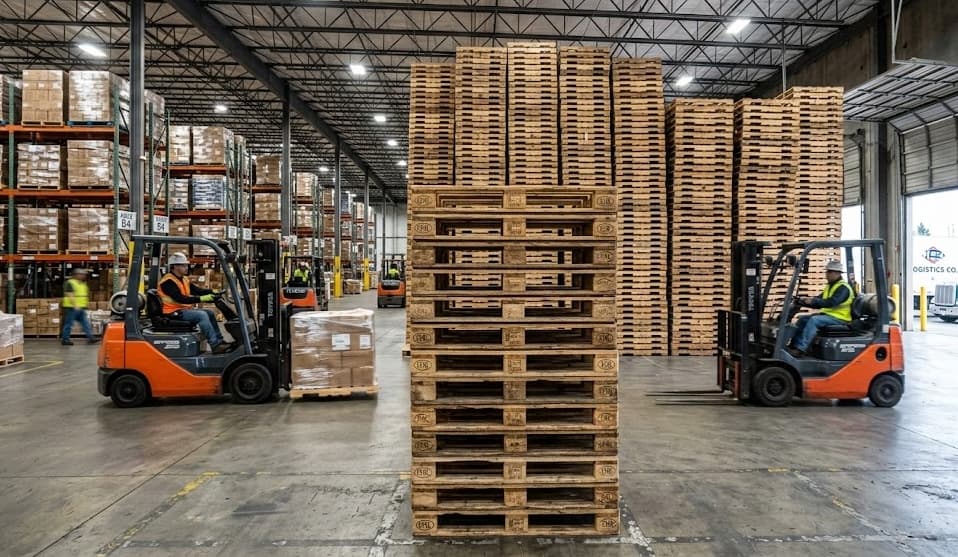
Repair, Don't Replace
Pallet Repair & Refurbishment
Extend the life of your pallets with expert repair. Faster and cheaper than buying new.
Save Up to 70% vs. Buying New
Most damaged pallets can be repaired for a fraction of the cost of a new one. Our skilled technicians replace broken boards, reset protruding nails, reinforce weak points, and restore structural integrity.
The result? A fully functional pallet that meets industry standards at 30-70% less than a new pallet. It's better for your bottom line and better for the planet.
Every repaired pallet is one less pallet that needs to be manufactured from virgin timber. With approximately 2 billion pallets in circulation in the US, repair is one of the most impactful sustainability choices a business can make.
We repair all standard and non-standard pallet sizes. Our facility handles stringer pallets, block pallets, skids, and specialty platforms. Whether you need 10 pallets fixed or 10,000, we deliver consistent quality on predictable timelines.
Our repair services include:
When to Repair vs. Replace
Repair When:
- - 1-3 boards are broken or missing
- - Nails are protruding but structure is sound
- - Minor damage to stringers or blocks
- - Cosmetic wear but no structural issues
- - Repair cost is less than 60% of replacement
- - Pallet is a standard size with available parts
Replace When:
- - Multiple stringers or blocks are cracked through
- - More than 50% of boards need replacement
- - Mold, rot, or insect damage has compromised integrity
- - Cost of repair exceeds 60% of a new pallet
- - Pallet has been repaired multiple times already
- - Load rating can't be maintained after repair
Repair Economics
Our Repair Process
A systematic, quality-controlled process that ensures every repaired pallet meets industry standards.
Collection
We pick up damaged pallets from your facility using our own fleet. Free pickup for qualifying volumes. Pallets are transported securely to our repair facility.
Assessment
Each pallet is individually inspected and assessed. We determine whether repair is economical (< 60% of replacement cost) or if the pallet should be recycled instead.
Dismantling
Damaged components are carefully removed. Reusable boards and stringers are preserved. Nails and fasteners are extracted cleanly to prevent damage to good components.
Replacement
Broken boards, cracked stringers, and damaged blocks are replaced with matching-grade components. We maintain large inventories of repair stock in all common sizes and species.
Assembly & Fastening
Repaired pallets are reassembled using pneumatic nail guns with the correct nail pattern, length, and type. All fasteners are properly set with no protrusions.
Inspection & Grading
Every repaired pallet undergoes a final quality inspection. It's graded (A, B, or C), stacked, and prepared for delivery back to your facility.
Common Damage Types We Repair
Our technicians handle every type of pallet damage — from minor cosmetic issues to major structural repairs.
Broken Deck Boards
Cracked or split top or bottom boards from forklift impact or overloading
Missing Boards
Boards lost during handling, shipping, or storage — replaced with matching lumber
Cracked Stringers
Partial or full stringer cracks from side impacts or overweight loads
Protruding Nails
Nails pushed up from impacts — reset or replaced to eliminate safety hazards
Damaged Notches
Broken notches that prevent proper forklift entry — rebuilt or reinforced
Block Damage
Cracked or split blocks on block-style pallets — replaced with matching blocks
Warped Boards
Boards bent from moisture exposure — replaced to restore flat, stable surface
Lead Board Damage
Front-facing boards damaged from frequent forklift engagement — high-priority repair
Managed Repair Program
High-volume operations benefit most from our managed repair program. Instead of disposing of damaged pallets and buying new ones, we create a sustainable repair loop that dramatically reduces your total pallet spend.
Here's how it works: we pick up damaged pallets from your facility on a regular schedule, repair them at our facility, and return them ready to use. You get consistent quality, predictable costs, and zero hassle.
Program Cost Savings Example
Here's a real-world example of how our managed repair program saves money for a distribution center processing 2,000 pallets per month:
What We Fix & How
Repair Scenarios in Detail
Here are four of the most common repair situations our technicians handle every day, along with exactly how we approach each one.
Broken Stringer
Replace & Reinforce
The Problem
A cracked or broken stringer is one of the most common types of pallet damage. It typically occurs from forklift impacts, overloading, or stress from repeated use. A compromised stringer weakens the entire pallet structure and creates a safety hazard.
Our Repair
Our technicians remove the damaged stringer section and replace it with a matching-grade component. For partial breaks, we install a companion stringer — a reinforcing piece bolted alongside the damaged area — which restores full load capacity. All fasteners are pneumatically driven and set flush.
The Result
The repaired pallet meets or exceeds original load-bearing specifications. Companion stringer repairs actually create a stronger joint than the original construction in many cases.
Split Deck Board
Swap with Kiln-Dried Lumber
The Problem
Deck boards split from forklift tine impacts, heavy point loads, or exposure to moisture cycles that cause wood to expand and contract. Split boards can snag products, injure workers, and compromise load stability.
Our Repair
The split board is removed cleanly, preserving adjacent boards and fastener holes. A replacement board of the same species, thickness, and width — sourced from our kiln-dried lumber inventory — is cut to length and fastened using the correct nail pattern. We use kiln-dried lumber specifically because it has lower moisture content, which reduces future warping and splitting.
The Result
The new board integrates seamlessly with the existing deck. Kiln-dried replacement lumber is actually more dimensionally stable than the original air-dried boards found on most pallets, reducing the chance of repeat failure.
Missing Blocks
Custom Block Replacement
The Problem
Block pallets rely on nine blocks (corners, edges, and center) to distribute load evenly. When blocks crack, split, or are knocked off entirely, the pallet loses structural integrity and cannot safely support loads on racking systems.
Our Repair
We manufacture replacement blocks in-house from hardwood or softwood to match the original specifications. Each replacement block is cut to the exact dimensions of the originals, ensuring proper fit and alignment with the deck boards and bottom boards. Blocks are secured with ring-shank nails for maximum holding power.
The Result
The repaired pallet returns to full racking compatibility and load capacity. Our custom-manufactured blocks ensure dimensional consistency across the entire pallet, eliminating wobble and instability.
Warped Frame
Straighten & Stabilize
The Problem
Pallets exposed to uneven moisture conditions — one side wet, one side dry — or stored improperly under heavy loads can develop warping and twisting. A warped pallet won't sit flat, creates instability in stacked loads, and can jam automated conveyor systems.
Our Repair
Our technicians assess the severity of the warp. For moderate cases, controlled pressure is applied to bring the frame back into alignment, and reinforcing components are added to hold the corrected shape. For severe warping, affected boards and stringers are replaced entirely with straight, kiln-dried components.
The Result
The pallet is restored to flat, stable condition. All repaired pallets are checked on a flat surface to confirm they sit level before being cleared for use. This is particularly important for pallets destined for automated warehouse systems.
Peace of Mind
90-Day Structural Warranty
Every pallet we repair comes with a 90-day structural warranty. If any repaired component fails under normal use within the warranty period, we'll re-repair the pallet at no cost. No arguments, no fine print — just bring it back and we'll make it right.
Our warranty covers all structural repairs including board replacements, stringer and block repairs, reinforcement work, and fastener resetting. It applies to standard load conditions as specified for the pallet's grade and construction type.
We stand behind our work because we use quality materials, proven repair techniques, and thorough quality inspection at every stage. Our warranty claim rate is under 2% — and when claims do occur, they're handled immediately with priority processing.
Warranty Details
What's Not Covered
The warranty does not cover damage from misuse (exceeding rated load capacity), intentional damage, chemical exposure, fire, flood, or modifications made by others after our repair. Normal cosmetic wear from standard use is not considered a defect. When in doubt, contact us and we'll assess the situation — we always try to do right by our customers.
Extend Pallet Life
Preventive Maintenance Tips
Proper handling and storage can dramatically extend the useful life of your pallets. Follow these guidelines to reduce damage and get the most value from every pallet.
Proper Stacking
Weight Distribution
Forklift Handling
Storage Conditions
Repair FAQ
How long does pallet repair take?
Standard repair turnaround is 1-3 business days from receipt at our facility. Rush repair (24-hour turnaround) is available for an additional fee. Managed program clients receive priority processing.
Do you pick up damaged pallets for repair?
Yes. We offer free pickup for repair volumes of 50+ pallets within our primary service area. For smaller quantities, pallets can be dropped off at our facility or combined with a scheduled delivery.
What grade will my repaired pallets be?
We repair pallets to your specified target grade (A, B, or C). Each repaired pallet is inspected and graded before return. If a pallet can't be cost-effectively repaired to the target grade, we'll notify you and recommend alternatives.
Is there a minimum quantity for repair?
No minimum. We repair as few as 1 pallet. However, repair pricing improves with volume — orders of 100+ typically receive the best per-pallet rates. Our managed program offers the best pricing for ongoing high-volume needs.
Can you repair non-standard or custom pallets?
Yes. We repair all pallet types including non-standard sizes, block pallets, and custom platforms. For specialty pallets, send us a photo or sample and we'll confirm we can match the components.
What do you do with pallets that can't be repaired?
Pallets that are beyond economical repair enter our recycling stream. The wood is salvaged for other repairs, chipped into mulch, or processed into biomass fuel. Metal fasteners are recycled. Nothing goes to landfill.
Common Questions
Frequently Asked Questions
What types of pallet damage can you repair?
We repair broken deck boards, cracked stringers, damaged lead boards, loose or missing fasteners, and structural weaknesses. If a pallet can be safely restored, our technicians will fix it.
How much does pallet repair cost compared to buying new?
Pallet repair typically costs 50-70% less than purchasing a new pallet. The exact savings depend on the extent of damage and the type of pallet being repaired.
What is the turnaround time for pallet repair?
Standard repair orders are completed within 2-3 business days. Rush service is available for time-sensitive needs. High-volume repair programs can be scheduled for ongoing turnaround.
Can you repair pallets on-site at my facility?
We primarily repair pallets at our North Highlands facility where we have full equipment and quality control processes. Pickup and delivery of pallets for repair is available through our fleet.
Do repaired pallets meet the same quality standards as new?
Yes, every repaired pallet is inspected and graded using the same standards as our recycled inventory. Repaired pallets meet or exceed their rated grade specification before leaving our facility.
Prevent Damage Before It Happens
Preventive Maintenance Checklist
Following these practices can reduce your pallet damage rates by 30-50%, saving significant repair and replacement costs.
Train Forklift Operators
Most pallet damage occurs during handling, not under load. Train operators to center forks before lifting, avoid dragging pallets, and approach loads at the correct angle. Even basic training reduces damage rates by 20%.
Match Pallets to Loads
Using an undersized or low-grade pallet for a heavy or critical load is the fastest way to cause damage. Match pallet grade and size to the actual load requirements. Use Grade C for light, one-way shipments. Use Grade A or custom builds for heavy, multi-trip loads.
Control Stack Height
Limit loaded pallet stacks to the pallet’s rated capacity. Overloading the bottom pallet in a stack causes compression failure in stringers and deck boards. When in doubt, use racking rather than floor stacking.
Inspect on Receipt
Check incoming pallets before they enter your product flow. A cracked stringer or loose board is much cheaper to catch at the dock than to discover after a product is loaded, shipped, and arrives damaged.
Store Properly
Empty pallets stored outdoors in rain and sun degrade 3-5x faster than covered pallets. If outdoor storage is unavoidable, rotate stock frequently and keep pallets off bare dirt to prevent moisture wicking.
Repair Early
A $2 repair today prevents a $10 failure tomorrow. When you spot a loose board, cracked stringer, or protruding nail, pull that pallet from service and repair or replace immediately. Small damage propagates under load.