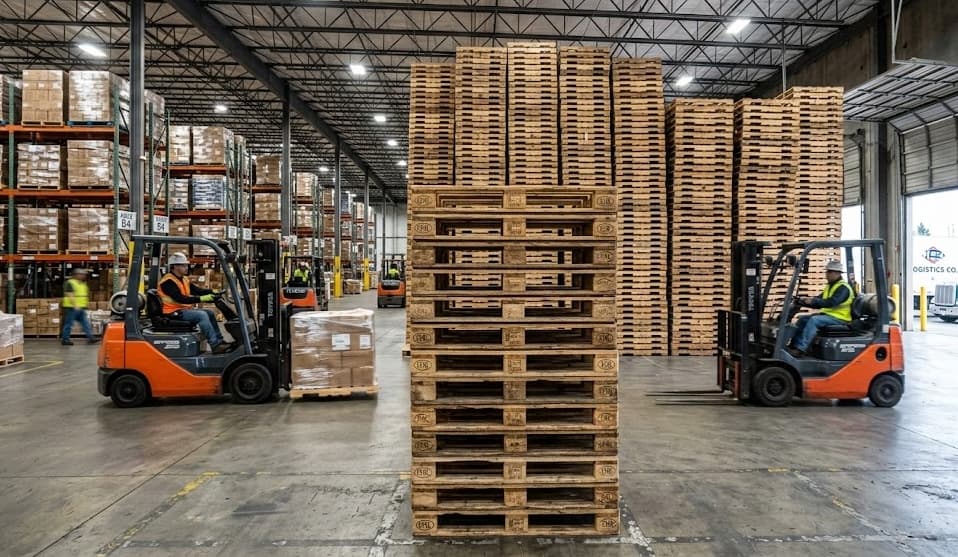
What We Offer
Our Products
From standard recycled wood pallets to specialized plastic options, we have the right pallet for every need.
Wood Pallets
Our most popular category. Recycled hardwood and softwood pallets in standard and custom sizes. Available in Grade A, B, and C with heat treatment options.
- GMA 48x40 Standard
- 42x42 & 48x48 Available
- All Grades (A, B, C)
- Heat Treated Options (ISPM 15)
Plastic Pallets
Durable, hygienic, and long-lasting. Ideal for clean environments, export shipping, and automated warehouse systems. 10+ year lifespan.
- Nestable & Stackable
- FDA Compliant Options
- Lightweight (50% less)
- No Heat Treatment Needed
Custom Pallets
Need something specific? We build pallets to your exact specifications — any size, any material, any quantity. Free prototypes available.
- Any Size Available
- Mixed Materials
- Special Load Ratings
- Prototype Services
Accessories
Complete your pallet solution with collars, covers, dividers, corner protectors, anti-slip mats, and reusable bands.
- Pallet Collars
- Covers & Lids
- Dividers
- Corner Protectors
Quality Guide
Understanding Our Grades
Our transparent grading system ensures you know exactly what you're getting. Every pallet is individually inspected and classified.
Grade A
Premium / Like New
Pallets in excellent condition with minimal cosmetic wear. No broken boards, no protruding nails, consistent color. Ideal for customer-facing applications, retail displays, pharmaceutical, and food industry.
Grade B
Standard / Good
Fully functional pallets with some cosmetic wear and minor repairs. All boards are intact and structurally sound. Best value for warehouse use, distribution, and general freight shipping.
Grade C
Economy / Fair
Pallets with visible wear and repairs but still structurally sound for most applications. Lowest cost option for one-way shipping, heavy-duty storage, export, or utility use.
Why Buy From Us
40-60%
Less Than New
Recycled pallets at a fraction of new pallet cost
50K+
Pallets In Stock
Large inventory for immediate availability
24hr
Delivery
Next-day delivery on most in-stock items
15+
Years Experience
Trusted by 500+ businesses across Sacramento
Industries We Serve
We supply pallets and accessories to businesses across every major industry in the Sacramento region and beyond.
Compare Options
Pallet Comparison Matrix
Not sure which pallet type is right for your operation? This side-by-side comparison covers the key factors that matter most when choosing between wood, plastic, and custom pallets.
Decision Guide
How to Choose the Right Pallet
The best pallet depends on your specific use case. Here's a quick guide to help you match the right pallet type to your application.
One-Way Shipping
Economy Wood (Grade B/C)
When pallets won't come back to you, economy-grade recycled wood pallets are the clear winner. They provide reliable structural performance at the lowest possible per-unit cost — typically $5-$10 each.
Warehouse Racking
Plastic or Hardwood (Grade A)
Racking systems demand dimensional consistency and high load ratings. Plastic pallets offer the most uniform dimensions for automated retrieval, while premium hardwood delivers maximum strength for heavy static loads.
International Export
Heat-Treated Wood (ISPM 15)
International shipments require ISPM 15 compliance for wood pallets. Heat-treated wood pallets carry the required HT stamp. Alternatively, plastic pallets are completely exempt from ISPM 15 regulations.
Food & Pharmaceutical
Plastic Pallets
FDA and GMP environments require non-porous, washable surfaces that won't harbor bacteria or absorb spills. Plastic pallets are the industry standard for food processing, pharmaceutical manufacturing, and cleanroom operations.
Heavy Equipment & Machinery
Custom Hardwood
Oversized or extremely heavy loads require custom-engineered pallets. Our heavy-duty hardwood platforms can be designed for loads up to 30,000 lbs with reinforced stringers, steel hardware, and integrated skid rails.
Retail & Display
Grade A Wood or Plastic
Customer-facing environments demand pallets that look professional. Grade A wood pallets offer a clean, uniform appearance at moderate cost, while plastic pallets provide the most consistent aesthetics with zero splinter risk.
Material Science
Hardwood vs. Softwood: Understanding the Difference
The type of lumber used in a pallet directly affects its strength, weight, lifespan, and cost. Knowing the differences helps you choose the right pallet for your application.
Hardwood Species
Oak, Maple, Birch, Beech, Ash
Hardwoods come from deciduous (leaf-shedding) trees and are characterized by dense grain structure and high compressive strength. They are the premium choice for heavy-duty pallet applications where maximum load capacity and long service life are critical.
Oak is the hardest commonly used pallet wood, with a Janka hardness rating of 1,290 lbf. It excels in applications requiring pallets to support 2,500+ lbs under dynamic load conditions. Maple follows closely at 1,450 lbf and offers superior moisture resistance, making it ideal for outdoor storage and cold chain applications.
Softwood Species
Pine, Spruce, Fir, Cedar, Poplar
Softwoods come from coniferous (evergreen) trees and grow significantly faster than hardwoods, making them more abundant and affordable. They are the workhorse of the pallet industry, accounting for the majority of pallets produced in North America.
Southern Yellow Pine is the most common pallet softwood, offering a strong balance of structural performance and cost-effectiveness with a Janka hardness of 870 lbf. It handles dynamic loads up to 2,000 lbs reliably. Spruce is lighter and best suited for single-use export shipping where low weight reduces freight costs.
Key Structural Factors
Moisture Content
Lumber moisture content directly affects pallet weight, strength, and susceptibility to mold. Kiln-dried lumber (below 19% moisture) is lighter, more dimensionally stable, and resists fungal growth. Green lumber (above 19%) is cheaper but heavier and more prone to warping, shrinking, and mold development in humid environments. For food and pharmaceutical applications, kiln-dried or heat-treated lumber is strongly recommended.
Grain Structure & Strength
Tight, straight grain patterns indicate higher structural strength and resistance to splitting. Boards with cross-grain, excessive knots, or irregular growth patterns are weaker and more likely to fail under load. Our grading process evaluates grain quality to ensure every pallet board meets the minimum structural requirements for its rated grade. Premium Grade A pallets use only straight-grained boards with minimal defects.
Fastener Holding Power
A pallet is only as strong as its connections. Denser hardwoods hold nails and screws more securely than softwoods, which is why hardwood pallets withstand more reuse cycles before requiring repair. We use spiral-shank and ring-shank nails that resist withdrawal forces 40-60% better than smooth-shank nails, providing superior joint integrity regardless of wood species.
Educational Resource
Anatomy of a Pallet
Understanding pallet construction helps you make better purchasing decisions. Here are the key components of a standard wooden pallet.
Top Deck Boards
The horizontal boards on the top surface where goods are placed. A standard 48x40 GMA pallet has 7 top deck boards. Board thickness (typically 5/8" to 3/4") and spacing affect load distribution and the pallet's ability to support point loads.
Bottom Deck Boards
Three or more horizontal boards on the underside that contact the floor or racking. Bottom boards provide stability, prevent the pallet from rocking, and distribute weight to the support structure below.
Stringers (Stringer Pallets)
Three parallel 2x4 or 3x4 boards running the length of the pallet that connect the top and bottom decks. Stringers are the primary structural members and bear the load transferred from the deck boards. Stringer pallets allow forklift entry from two sides only.
Blocks (Block Pallets)
Nine or twelve solid wood blocks arranged in a grid pattern that support the deck boards. Block pallets allow four-way forklift entry since there are no continuous stringers blocking access from any side.
Lead Boards
The outermost top deck boards at both ends of the pallet. Lead boards experience the most stress during handling and are the most commonly damaged component. They are often 5/8" thick and the first component replaced during repair.
Notches (Stringer Pallets)
Cutouts in the bottom edge of stringers that allow partial four-way forklift access. Notched stringers compromise slightly on strength but gain the major advantage of accessibility from all four sides, making them the most popular stringer design.
Chamfered Edges
Beveled corners on lead boards and bottom boards that help guide forks during insertion, reducing damage to both the pallet and the forklift. Chamfers are standard on Grade A pallets and are a mark of quality construction.
Common Questions
Frequently Asked Questions
What types of pallets do you sell?
We sell recycled wood pallets in Grade A, B, and C, durable plastic pallets, custom-built pallets to any specification, and accessories including collars, covers, and dividers.
What is the difference between Grade A, B, and C pallets?
Grade A pallets are in near-new condition with minimal cosmetic wear. Grade B pallets are structurally sound with some visible use. Grade C pallets are functional but show significant wear, ideal for one-way shipping.
Do you offer heat-treated pallets for export?
Yes, all our wood pallets are available with ISPM 15 heat treatment for international shipping. Treated pallets come with the official IPPC stamp and full documentation.
What is your minimum order quantity?
We have no strict minimum for standard sizes. Whether you need 10 pallets or 10,000, we can accommodate your order with competitive pricing and fast delivery.
Can I visit your facility to inspect pallets before buying?
Absolutely. Walk-ins are welcome during business hours at our North Highlands facility. You can inspect inventory, discuss your needs, and arrange pickup or delivery on site.
Get More Life From Your Pallets
Pallet Care Best Practices
Proper handling and storage can double or triple your pallet lifespan. Follow these guidelines to protect your investment.
Stack Safely
Limit empty pallet stacks to 15 high or 6 feet, whichever is less. Use flat, level surfaces. Taller stacks become unstable and pose a toppling hazard, especially outdoors.
Store Under Cover
Prolonged rain, sun, and temperature extremes accelerate wood degradation. Store pallets indoors or under a roof whenever possible. If outdoor storage is unavoidable, orient stacks so top boards shed water.
Rotate Stock
Use a first-in, first-out system for your pallet inventory. Pallets left sitting for months degrade faster. Regular rotation ensures even wear across your stock and prevents any pallets from deteriorating in storage.
Inspect Before Use
Train staff to check pallets before loading. Look for split boards, protruding nails, broken stringers, and contamination. Catching damage before a pallet enters your product flow prevents downstream problems.
Handle With Care
Forklift operators should center forks before lifting and avoid dragging pallets across rough surfaces. Most pallet damage occurs during handling, not under load. Better handling extends pallet life dramatically.
Repair Small Damage Early
A loose board costs $1 to fix today. Ignored, it becomes a broken board that costs $3-5 to replace next week, or a failed pallet with product damage that costs hundreds. Early repair is always the most economical choice.