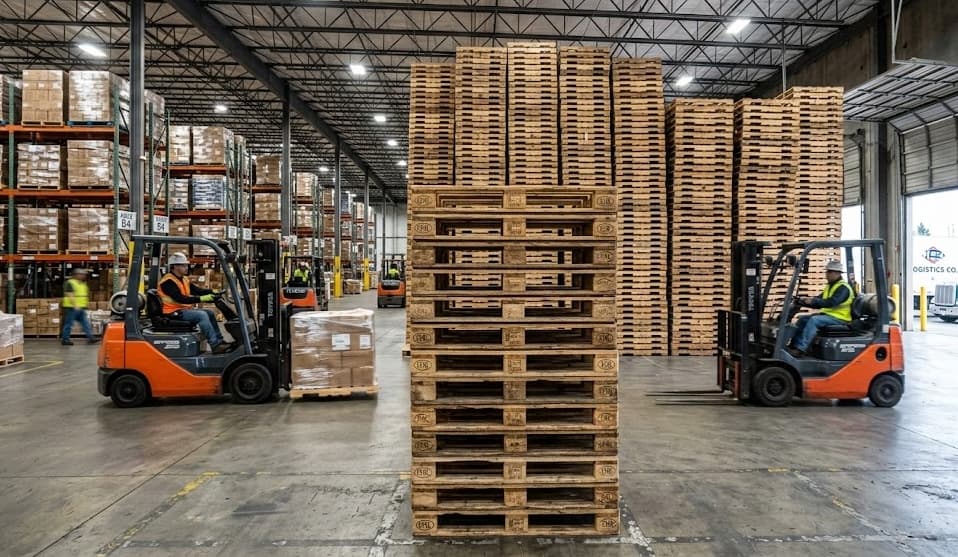
Our Best Sellers
Recycled Wood Pallets
Premium-quality used wood pallets in standard and custom sizes. Every grade, every size — all sustainably sourced.
Why Choose Recycled Wood Pallets?
Recycled wood pallets offer the same structural performance as new pallets at 40-60% lower cost. Our rigorous inspection and repair process ensures every pallet meets industry standards for its rated grade.
Wood pallets remain the gold standard for shipping and warehousing due to their strength, repairability, and sustainability. Unlike plastic, damaged wood pallets can be repaired quickly and economically, extending their useful life by years.
40-60%
Cost Savings vs. New
6-10
Average Reuse Cycles
100%
Recyclable at End of Life
ISPM 15
Heat Treatment Available
Available Wood Species
Southern Yellow Pine
Strong, affordable, most common in the US
Oak (Red & White)
Extremely durable, dense, premium grade
Poplar / Aspen
Lightweight, clean appearance, great for exports
Mixed Hardwood
Blend of species, excellent value, versatile
Popular Sizes
Standard Pallet Dimensions
48" x 40"
GMA Standard
The most common pallet size in North America. Used in grocery, retail, and general freight. Compatible with standard racking systems.
42" x 42"
Telecom / Paint
Popular in the telecommunications and paint industries. Square shape allows optimal use on ocean containers and intermodal shipping.
48" x 48"
Drum / Industrial
Designed for drums, barrels, and industrial products. Square shape accommodates round containers efficiently and maximizes trailer space.
48" x 42"
Automotive
Standard in the automotive industry. Slightly wider than GMA to accommodate automotive parts trays and containers.
Wood Science
Lumber Species Deep Dive
Different wood species offer different performance characteristics. Understanding these properties helps you select the optimal pallet for your load requirements and budget.
Oak (Red & White)
HardestOak is the densest and hardest wood commonly used in pallet construction. With a Janka hardness rating of 1,290 lbf (white oak) to 1,220 lbf (red oak), it provides unmatched resistance to impact damage and compression failure. Oak pallets are the preferred choice for the heaviest loads — rated for 2,500+ lbs dynamic capacity in standard 48x40 configurations.
Best for: Heavy machinery, racking systems, long-term reuse programs, high-value cargo
Maple (Hard & Soft)
Most DurableMaple offers excellent durability with superior moisture resistance compared to most other pallet woods. Hard maple (1,450 lbf Janka) is one of the strongest available species, while soft maple (950 lbf) provides a more affordable alternative with impressive performance. Maple's tight grain structure resists absorption, making it ideal for outdoor storage and cold chain applications.
Best for: Cold storage, outdoor use, food & beverage, moisture-prone environments
Pine (Southern Yellow)
Most CommonSouthern Yellow Pine is the backbone of the North American pallet industry. It offers the best balance of structural strength, availability, and cost-effectiveness. With a Janka hardness of 870 lbf, pine handles dynamic loads up to 2,000 lbs reliably in standard configurations. Its widespread availability ensures consistent supply and competitive pricing year-round.
Best for: General shipping, warehousing, retail distribution, most standard applications
Spruce
LightweightSpruce is the lightest commonly used pallet wood, making it the preferred choice for single-use and export shipping where freight weight directly impacts cost. With a Janka hardness of 490 lbf, spruce is softer than pine but structurally adequate for light-to-medium loads. Its low weight (25-35 lbs for a 48x40 pallet) can save meaningful freight cost per truckload.
Best for: Export shipping, one-way use, lightweight products, air freight
Specifications
Load Capacity by Size
Load ratings vary by pallet size, wood species, and construction type. These figures represent typical capacities for standard stringer-style pallets using mixed hardwood/softwood lumber.
Understanding Load Types
Dynamic Load
The maximum weight the pallet can support while being moved by a forklift or pallet jack. This is the most commonly referenced capacity rating.
Static Load
The maximum weight the pallet can support when sitting stationary on the floor or on top of another pallet. Typically 2x the dynamic rating.
Racking Load
The maximum weight the pallet can support when placed on racking beams with unsupported spans. This is the most demanding load scenario.
Care & Maintenance
Storage & Handling Best Practices
Proper storage and handling can extend the useful life of your wood pallets by 2-3x. Follow these guidelines to maximize your investment and maintain pallet performance.
Keep Pallets Off the Ground
Store pallets on a raised surface, concrete pad, or pallet rack — never directly on bare soil or wet ground. Ground contact promotes moisture absorption, accelerates wood rot, and attracts termites and other pests. Even a simple gravel pad with drainage significantly extends pallet lifespan.
Ensure Adequate Ventilation
Stack pallets with spacing to allow airflow between layers. Poor ventilation traps moisture and creates conditions for mold and fungal growth. In enclosed storage areas, use fans or ensure cross-ventilation. Indoor climate-controlled storage is ideal for premium Grade A pallets.
Rotate Your Stock (FIFO)
Use a first-in, first-out rotation system to ensure older pallets are used before newer ones. This prevents long-term static storage from weakening pallets through sustained compression and moisture exposure. Consistent rotation also makes it easier to identify and cull damaged units.
Inspect Pallets Regularly
Before each use, check for broken or cracked boards, protruding nails, signs of rot, insect damage, and excessive warping. Catch small problems early — a single cracked board is a $0.50 repair, but a collapsed pallet under load can cause thousands in product damage and potential injury.
Avoid Prolonged Moisture Exposure
Wood pallets can tolerate occasional contact with water, but prolonged exposure leads to swelling, weakening, mold, and decay. If outdoor storage is unavoidable, cover pallet stacks with tarps or waterproof sheeting. Ensure covers allow airflow to prevent condensation buildup underneath.
Stack Heights & Weight Limits
Do not exceed recommended stack heights — typically 5-6 pallets high for empty stacks. Loaded pallets should never be stacked more than 2-3 high without racking support. Excessive stacking compresses bottom pallets and causes permanent warping, especially in humid conditions.
Quick Reference: Pallet Lifespan by Storage
Signs a Pallet Needs Replacement
Wood Pallet FAQ
How long do wood pallets last?
The lifespan of a wood pallet depends on the wood species, grade, how it’s used, and how it’s stored. In a typical warehouse environment with moderate handling, a Grade A hardwood pallet can last 5-10 years and withstand 6-10 reuse cycles. Grade B pallets typically last 3-5 years. Economy Grade C pallets used for one-way shipping may only be used once or twice. Proper storage — off the ground, ventilated, and sheltered from weather — can extend lifespan by 2-3x.
Can wood pallets get wet?
Wood pallets can handle occasional exposure to water without significant damage. However, prolonged or repeated moisture exposure causes swelling, warping, mold growth, and accelerated decay. If your pallets will be exposed to moisture regularly, choose hardwood species like oak or maple that have natural moisture resistance, or request kiln-dried lumber that starts at a lower moisture content. Always allow wet pallets to dry completely before stacking or storing them.
How can I tell what grade a pallet is?
Grade A pallets are in like-new condition with no broken boards, no stains, all nails flush, and a uniform appearance. Grade B pallets are fully functional with minor cosmetic wear — you may see slight discoloration, small surface marks, or 1-2 replacement boards that are a slightly different shade. Grade C pallets have visible wear, multiple repairs, possible staining, and noticeable cosmetic imperfections but remain structurally sound. Our pallets are clearly marked with their grade. If you’re unsure, our team can help you identify the grade you need.
What is the maximum weight a wood pallet can hold?
Standard 48x40 GMA wood pallets are typically rated for 2,500 lbs dynamic load (while being moved by a forklift) and 5,000 lbs static load (sitting on the floor). However, maximum capacity varies significantly by wood species, construction type, and pallet condition. Hardwood pallets made from oak can handle 3,000-3,500 lbs dynamic. Custom heavy-duty pallets with reinforced stringers can be engineered for dynamic loads up to 5,000 lbs and static loads exceeding 30,000 lbs.
What is ISPM 15 heat treatment and when is it required?
ISPM 15 (International Standards for Phytosanitary Measures No. 15) is an international regulation that requires all wood packaging materials used in international trade to be heat treated or fumigated to kill pests. Heat treatment involves raising the core temperature of the wood to 56°C (132.8°F) for a minimum of 30 minutes. Once treated, pallets are stamped with the IPPC/HT mark. Heat treatment is required for virtually all international shipments using wood pallets — the U.S., EU, China, Australia, and most other countries enforce this standard. We offer ISPM 15 heat treatment on all our wood pallets.
How are wood pallets recycled at end of life?
Wood pallets that are no longer suitable for repair go through a multi-step recycling process. First, usable boards and components are salvaged and used to repair other pallets. Remaining wood is processed through a grinder and converted into wood mulch, animal bedding, biomass fuel, or composite wood products. Nails and fasteners are magnetically separated and recycled as scrap metal. At Sacramento Pallet, we recycle 100% of the wood and metal from end-of-life pallets — nothing goes to landfill. We also offer free pallet pickup for businesses with pallets to dispose of.
What is the difference between a stringer pallet and a block pallet?
Stringer pallets use two or three parallel boards (stringers) running between the top and bottom deck boards. They are the most common type in North America, typically offering 2-way forklift entry (or 4-way with notched stringers). Block pallets use solid wood blocks at the corners and center to support the deck boards, allowing full 4-way forklift access. Block pallets are generally stronger and more compatible with automated handling systems, but cost more to manufacture. We stock both types in standard sizes.
Do you offer volume discounts on wood pallets?
Yes. Our pricing improves with volume. Orders of 100+ pallets receive preferred pricing, and orders of 500+ receive our best per-unit rates. We also offer standing order programs for businesses with recurring pallet needs — you lock in a price and delivery schedule, and we ensure your pallets are always available when you need them. Contact us with your estimated monthly volume for a custom quote.
Environmental Benefits
Why Recycled Wood Pallets Are the Green Choice
Choosing recycled wood pallets is one of the easiest ways to reduce your supply chain's environmental footprint.
Carbon Sequestration
Wood pallets store carbon absorbed during tree growth. Keeping them in circulation through reuse and repair means that carbon stays locked in the wood instead of being released through decomposition or incineration.
Reduced Deforestation
Every recycled pallet purchased is one less new pallet manufactured from virgin timber. With 400 million pallets discarded annually in the US, recycling even a fraction makes a measurable difference for forests.
Closed-Loop Material Flow
Our recycling process creates a true circular economy. Pallets enter, get sorted, repaired, and reissued. Damaged wood becomes mulch or biomass. Metal fasteners are recycled. Nothing is wasted.
Lower Transport Emissions
Locally recycled pallets travel a fraction of the distance that new pallets do. Our supply loop stays within a 50-mile radius, dramatically reducing the transportation-related carbon footprint per pallet.
Common Questions
Frequently Asked Questions
What sizes of wood pallets do you carry?
We carry all standard sizes including 48x40 GMA, 42x42, 48x48, 36x36, and 48x45. We also build custom sizes to your exact specifications.
What wood species are used in your pallets?
Our recycled pallets include both hardwood and softwood species. Hardwood pallets offer greater durability for heavy loads, while softwood options are lighter and more economical.
How do you grade your wood pallets?
We use a transparent three-tier system. Grade A pallets are near-new with minimal wear. Grade B pallets are structurally sound with visible use. Grade C pallets are functional for light-duty or one-way applications.
Can wood pallets be heat treated for international shipping?
Yes, we offer ISPM 15 certified heat treatment for all wood pallets. Treated pallets receive the official IPPC stamp required for international export compliance.
How long do recycled wood pallets last?
A well-maintained recycled pallet can last through 6-10 use cycles. With our repair services, damaged pallets can be restored to extend their life even further.
Ready to Order?
How to Order Wood Pallets
Tell Us What You Need
Share pallet size, quantity, grade preference, and delivery location via phone, email, or our contact form.
Get Your Quote
We respond within 24 hours with a clear, itemized quote including delivery. No hidden fees.
Confirm & Schedule
Approve the quote and we schedule delivery at your preferred time. Same-day available for Sacramento metro.
Receive & Inspect
Our driver delivers and you verify count and quality on-site. Any issues are resolved on the spot.