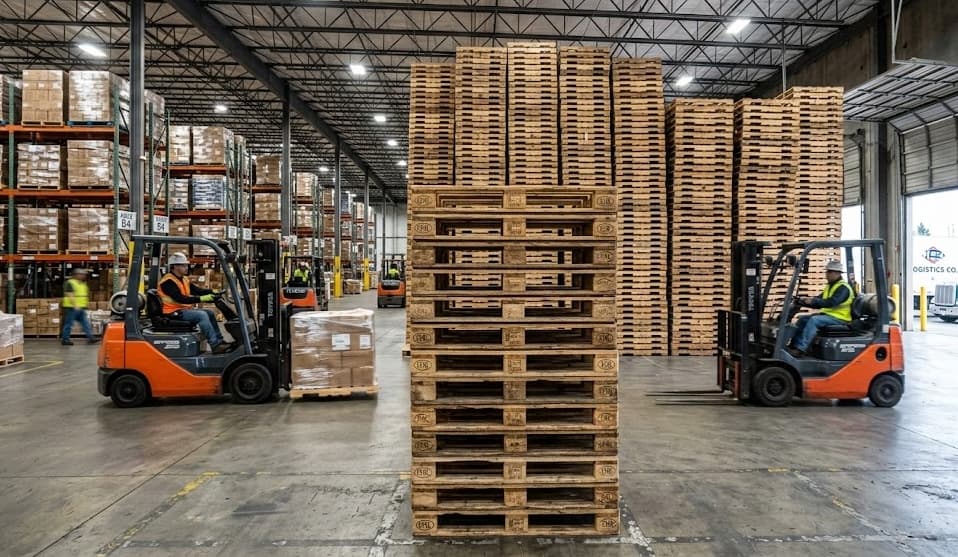
When it comes to sourcing pallets for your operation, there are two fundamental models: buying and owning your pallets outright, or renting them through a pallet pooling service. Both have their place, but choosing the wrong model can cost you thousands annually.
What Is Pallet Pooling?
Pallet pooling is essentially a rental program. Companies like CHEP (blue pallets) and PECO (red pallets) own large fleets of standardized pallets that they rent to shippers. You pay a per-trip or daily fee, and the pooling company handles retrieval, repair, and redistribution.
The appeal is simplicity — you never have to worry about pallet inventory, repair, or disposal. But that convenience comes at a price, and for many businesses, the costs add up faster than expected.
The True Cost of Pooling
Pooling fees typically include a per-issue fee ($4-8 per pallet), a daily rental fee ($0.10-0.25), and transfer fees when pallets move between locations. Lost or damaged pallets incur penalty charges that can range from $15-25 per pallet.
For a business shipping 500 pallets per month with an average cycle time of 30 days, annual pooling costs can easily exceed $50,000-80,000. That's before factoring in lost pallet penalties, which industry studies suggest affect 10-15% of pooled pallets.
The Case for Ownership
Owning your pallets — especially recycled ones — eliminates per-trip and daily fees entirely. A Grade B recycled pallet purchased for $5-7 can be used dozens of times over several years, making the per-use cost essentially pennies.
The tradeoff is that you're responsible for inventory management, repair, and replacement. But partnering with a local pallet recycler like Sacramento Pallet Co. makes this easy — we handle repair, buyback of damaged pallets, and replenishment of your stock.
When Pooling Makes Sense
Pooling can make sense for businesses with complex supply chains where pallet retrieval is difficult, companies shipping to many dispersed retail locations, businesses with highly seasonal volumes that would leave owned pallets idle for months, and operations that lack space to store pallet inventory.
When Ownership Makes Sense
Ownership makes sense for businesses with predictable, consistent pallet usage, closed-loop supply chains with reliable pallet returns, companies with space for pallet storage, budget-conscious operations looking to minimize per-pallet costs, and businesses near a reliable pallet recycler for repair and replenishment.
Our Recommendation
For most small and mid-sized businesses, purchasing recycled pallets is the more cost-effective option. The initial investment is low, especially with Grade B or C pallets, and the ongoing costs are a fraction of pooling fees. Combined with a repair and buyback relationship with Sacramento Pallet Co., ownership gives you full control over costs and quality.