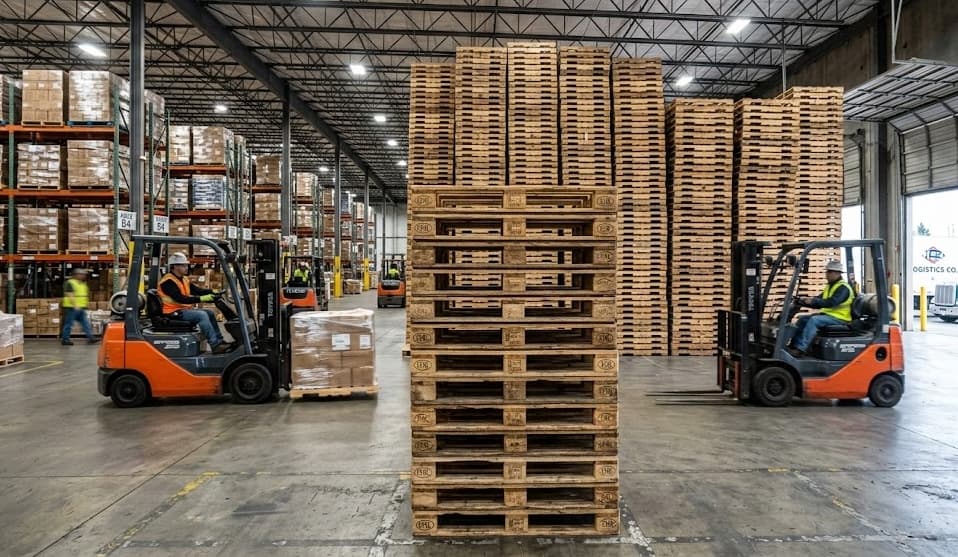
People often ask us: what exactly happens to pallets after you collect them? The answer involves a careful, multi-step process designed to extract the maximum useful life from every pallet while ensuring quality and safety. Here's a behind-the-scenes look.
Step 1: Receiving and Sorting
When pallets arrive at our facility — whether from a scheduled pickup, drop-off, or delivery — the first step is a rough sort. Pallets are separated by size (48x40, 42x42, etc.) and initial condition (obviously damaged vs. potentially reusable). This sorting happens quickly but sets the stage for everything that follows.
Step 2: Inspection
Each pallet goes through a detailed inspection. Our trained inspectors check every board, stringer, and block for cracks, splits, rot, mold, contamination, and nail condition. Pallets are categorized as either repairable or beyond repair. Pallets with contamination from chemicals, food spoilage, or hazardous materials are separated for specialized handling.
Step 3: Repair
Repairable pallets move to the repair line. Broken deck boards are replaced with matching salvaged lumber. Protruding nails are reset or replaced. Damaged stringers are reinforced or swapped. Lead boards (the outermost deck boards) get extra attention since they take the most abuse from forklifts.
Our repair technicians are skilled craftspeople who can restore a beat-up pallet to fully functional condition in minutes. The key is knowing when repair makes sense and when the pallet should move to recycling.
Step 4: Grading
After repair, pallets are graded: Grade A for pallets in near-new condition with minimal cosmetic wear, Grade B for fully functional pallets with moderate cosmetic wear, and Grade C for structurally sound pallets with significant cosmetic wear. Each grade is stored separately for easy fulfillment of customer orders.
Step 5: End-of-Life Recycling
Pallets that can't be economically repaired don't go to waste. They're broken down into components: salvageable boards are set aside for use in repairs. Unusable wood is chipped into mulch, landscaping material, animal bedding, or biomass fuel. Metal fasteners are collected and sent to metal recyclers. Even the sawdust from our operations is captured and repurposed.
The Result
Our process achieves a 98% landfill diversion rate. That means for every 100 pallets that enter our facility, at most 2% (by weight) ends up in a landfill — and we're working to improve even that number.